In the Belly of the Beast: Technician, Operator and Manufacturing Jobs at Proxima Fusion

The short answer
Proxima Fusion is a Munich-based company building stellarator fusion power plants, with additional offices and labs in Zurich (at the Paul Scherrer Institute) and Oxford (on the Culham Campus). We hire technicians, lab technicians, technical operators, manufacturing engineers, process engineers and procurement specialists to turn superconducting magnet research into repeatable, industrial production. You do not need a fusion background. Our teams come from automotive, aerospace, robotics and other manufacturing industries. We'd love to see your application come through.
Open roles: https://www.proximafusion.com/careers/open-positions
The shift from prototype to process, from R&D to reliable components and repeatable manufacturing, is the grand engineering challenge sitting underneath one of the more famous physics problems of our time: building a star on Earth. Building many means developing the tools, skills and supply chains to deliver them at scale.
At Proxima, that work advances on several fronts at once. As teams test and develop superconducting cables, others build the tooling, secure the materials and develop the systems needed for production. What each team learns helps shape the others' work. Welcome to our world.
From the bench to the line
Our CEO, Francesco Sciortino, likes to say we're not doing rocket science, it's actually much harder. Many teams are solving many different issues at the same time. And as much as working in a fusion energy lab can seem like science fiction from the outside, the people doing it every day use their skills and experience to adapt established tools and techniques to stellarator engineering.
Paul joined Proxima from an automotive apprenticeship in Germany. "That industry quickly became very mature in a sense, and I wanted to experiment a lot more," he says. "After some detours, I landed here, where everything is being built for the first time." He works in HTS cable manufacturing, on the tooling and processes that turn experimental methods into repeatable production.
"Recently we transitioned from crafted parts to machine components. At the same time, everything is very tangible. One example I can give is welding. We are basically using all the usual techniques that are required by other industries to address this massive complexity."
Arne, a lab technician, works on our cables and has been part of the HTS R&D task force since its earliest days. HTS tape is a material thinner than a human hair, with a superconducting layer just a few micrometres thick that can carry current with virtually no resistance. Only recently have the economics and manufacturing of this technology matured enough to make it viable, and Arne works right at the forefront of that shift.
He describes the same transition from his side of the bench: research to industrialization. "What we did is we took a research testing approach and built it into an industrial approach, which is massively different. In an industrial approach, you want consistent reliable results. And that is what we have managed to achieve." Building that from scratch became his own project within weeks of joining. There's no other way to describe the pace, he says, than: "There isn't a typical day. It feels like riding a bull."
Cables, SMC, Alpha all at once
Not everyone here has an engineering background. Alessandra studied foreign languages and international communication. "But I still believe it's about translation," she says. "Instead of between languages, it's between teams, between people, between operations."
She planned production across automotive, aerospace and eVTOLs before joining Proxima, and she's blunt about why she made the jump. "I wanted to be proud of something. Proud of the product, the technology, the mission I was part of. This is something bigger - something you want to be part of from the very beginning, from as soon as you can."
Alessandra coordinates the dependencies between design, procurement, process qualification and manufacturing. These activities often overlap: a design engineering phase defines what a machine part needs to survive; procurement starts securing materials the moment a render exists; process qualification - building the machines and the method - runs in parallel; and manufacturing itself runs as a sequence of steps checked at every gate, with parts and materials moving across the globe the whole way through.
What she's most insistent on is that none of this waits its turn. "SMC - our prototype magnet - is just a trampoline for Alpha, a testbed for freezing a design and a process before scaling it to full size." Cable production, SMC and early work on Alpha advance together, with lessons from building and testing informing manufacturing plans and future designs.
AI as the shortcut around tools that don't exist yet
Mike Adams, a manufacturing engineer who came to Proxima from autonomous vehicle and robotics companies, ran into a problem that has nothing to do with fusion physics: the tools on the market often don't fit the unique problems we are solving. So his team builds its own - a centralized system technicians can pull up to find test plans, production specs and R&D documentation fast. "AI has really allowed me to build that tool at a scale and a pace that was not previously possible."
He sees the same industrialization curve Paul and Arne describe, just from the data side. "We've been able to take a lot of the data from the production of our HTS cables and feed it back into our resource planning model, so that as we grow and start building out our magnet factory, we're not using educated guesses and theoretical tact times - we're using real data from our own machines."
Supply chains built for more than one machine
David leads procurement, having spent over a decade in aerospace before joining Proxima. "You are building something where you need long lead items. You have a supply chain which is evolving constantly." His team sources everything from HTS tape to cryogenic-grade stainless steel to the heating systems that get plasma hot enough to fuse - much of it not yet available off the shelf and developed jointly with suppliers.
The scale puts the ambition in perspective. SMC alone needs roughly ten times its finished weight in raw stainless steel. Alpha will need more than 40 of those magnets. "We are not only building a one-off prototype. We are building a whole supply chain to eventually build lots of Stellaris power plants." A one-of-a-kind supply chain, built for repetition and scale.
Who thrives in technician and manufacturing roles at Proxima?
People with hands-on technical skills who want to build something new. Backgrounds that fit include automotive, aerospace, aviation, robotics, electronics, welding, machining, cable and wire manufacturing, cryogenics and industrial automation (PLC programming). Arne's advice: "The only thing you need to bring is your technical skills - and your willingness to win the game."
Join us if you want to be part of our mission. Our careers page is open.
FAQ
Do I need a fusion or physics background to work at Proxima Fusion?
No. Many of our manufacturing and operations colleagues came from automotive, aerospace and robotics.
Where is Proxima Fusion located?
Proxima Fusion is headquartered in Munich, Germany, with additional offices and labs in Zurich, Switzerland (at the Paul Scherrer Institute) and Oxford, United Kingdom (on the Culham Campus)
What will I actually work on?
Building HTS superconducting cables and the tooling, processes and test benches around them, as part of the path from the SMC prototype magnet to Alpha and the Stellaris power plant.
What jobs is Proxima Fusion hiring for?
We are hiring across the board from research to production, and most of our open roles are in operations, manufacturing and supply chain. Current openings include:
- Technicians: Production Technician, Manufacturing Technician, Test Technician, Engineering Technician and Maintenance Technician (Gundremmingen/Günzburg); Technician and Electrical Technician, Magnet Systems (Zurich).
- Manufacturing and industrialization: Manufacturing Engineer (Munich); Manufacturing Engineer and Automation Engineer, Magnet Industrialisation (Zurich); Industrial Controls Engineer and Production Planner (Munich).
- Procurement and project management: Procurement Manager, Advanced Manufacturing; Procurement Manager, Construction and Infrastructure; Project Manager, Site & Infrastructure Development; Project Manager, General & Cross-Program (all Munich).
- Engineering, physics and software: including Electrical Control Engineer, Plasma Microwave Modelling Physicist, Head of Monitoring and Control, and software and AI roles.
All current roles are full time. See every open position on our careers page.
What is HTS?
HTS stands for high-temperature superconducting. HTS tape is a material thinner than a human hair with a superconducting layer just a few micrometres thick that carries current with virtually no resistance. Wound into cable and then into magnets, it produces the very strong magnetic fields a stellarator needs to confine plasma, in a more compact machine than older magnet technology allowed. HTS was a laboratory material a decade ago and is now an industrial product made worldwide, which is why building fusion magnets at scale is possible now.
What is a stellarator?
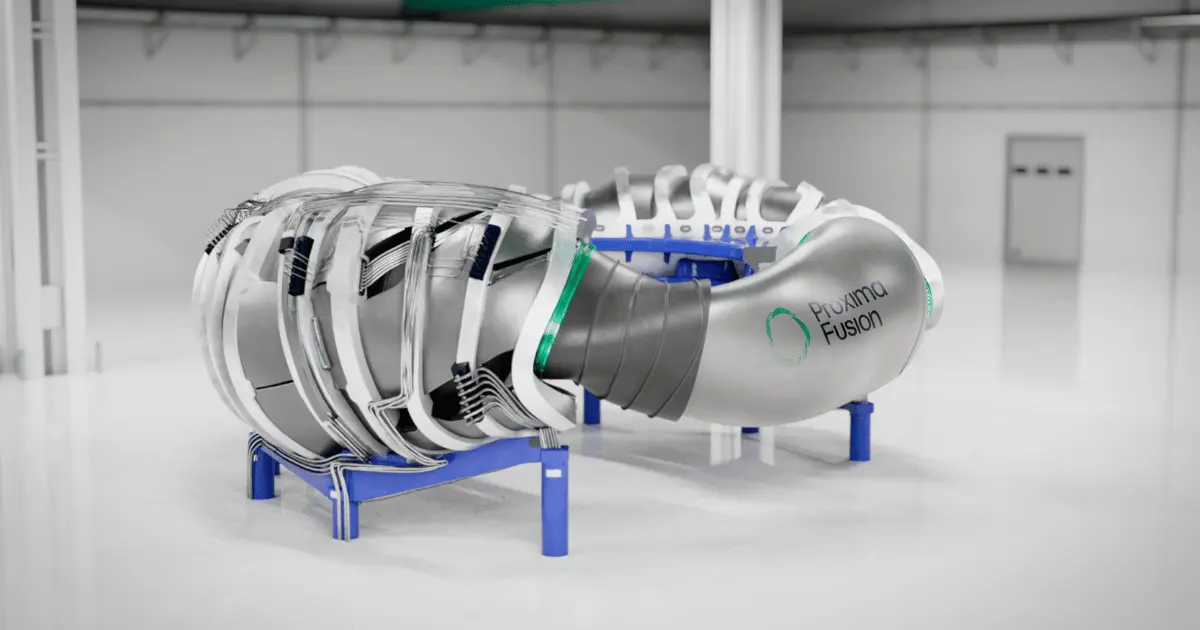
A stellarator is a fusion machine that holds a plasma, hydrogen gas heated past 100 million degrees, in place using only external magnets. It is a large, hollow donut wrapped in precisely shaped magnets, with the plasma levitating in the middle, never touching the walls. Proxima Fusion builds stellarators.
What is Alpha?
Alpha is Proxima's demonstration stellarator, designed to achieve net energy gain. It is planned for Garching, near Munich, in partnership with the Max Planck Institute for Plasma Physics.
What is Stellaris?
Stellaris is Proxima's commercial fusion power plant concept, the machine that comes after Alpha. A first-of-a-kind plant is planned for Gundremmingen in Bavaria, on the site of an existing power plant.
What does Proxima Fusion plan for the future?
We're building towards Stellaris, our commercial fusion power plant, with Alpha, our demonstrator stellarator, as the step before it. Alpha is planned for Garching and a first-of-a-kind Stellaris plant for Gundremmingen. Alpha alone needs more than 40 magnets, so we also plan to open a magnet factory in Gundremmingen and, with the State of Lower Saxony, to build Europe's first large-scale fusion-grade HTS tape facility.
Why work in manufacturing at a fusion company?
Because the manufacturing is the mission. Fusion power plants only exist if someone can produce superconducting cable and magnets reliably, repeatedly and at scale. As Paul puts it, this is a place "where everything is being built for the first time." We value personal achievement, and the responsibility to own what you build. We value commitment to our mission and we value teamwork, because no cable, magnet or machine gets built by one person.
Related Stories