Europe’s Turning Point for Fusion: Why Bavaria’s €400M Bet on Proxima Matters

By Francesco Sciortino, Proxima Co-Founder and CEO
Last week was a big one. Let me break down what it means – not just for Proxima, but for Europe's fusion future.
Last week's Memorandum of Understanding (MoU) between Proxima Fusion, Bavaria, RWE, and the Max Planck Institute for Plasma Physics (IPP) is a turning point for fusion in Europe. This marks the moment European fusion moves into industrial reality, with Proxima at the center of that shift. Like everyone in fusion, I came into the field to see it entering this new phase, and it’s spectacular to see it happen now.
The MoU is more than a partnership announcement. It is, in the words of RWE CEO Dr. Markus Krebber, "a cornerstone for future energy supply in Bavaria, Germany, and Europe." For the first time, world-class fusion science, capital, infrastructure, and political commitment are aligned behind a single project – going from demonstrator to commercial fusion power plant, in Europe.
Bavarian Minister-President Markus Söder perfectly captured the scale of what this coalition represents: "This is a completely new chapter in German energy policy, and for the whole world."
I couldn't agree more. For me, it’s also a moment of pride, seeing our public institutions coming together and recognizing that Europe needs to step up together with its private sector.
The Funding Architecture That Makes It Real
Bold ambitions require bold investment. MP Söder announced at the press conference that Bavaria is committing €400 million in state funding towards the Alpha project. This commitment is key to unlocking something equally important: German federal support. Under Germany's High-Tech Agenda, national funding follows demonstrated state-level commitment. More than €2.4B of public investment is already committed for the next three years by the German government in its Fusion Action Plan.
In the MoU, the four partners agreed on a joint project proposal. Söder made the goal clear: "We hope the federal government will also contribute, so that together we can reach over one billion euros for a major national project." Proxima will also step up to contribute €400M of private investment toward Alpha, which is estimated to cost €2B in total
What makes this moment exceptional isn't only the size of the financial commitments, but their sequencing. By committing first, Bavaria de-risks federal participation for the Alpha project and creates the conditions for private capital to follow. This is how large-scale industrial projects get built.
Proxima is currently the only fusion company in Germany with the level of state backing required to compete for that national support. In a global race where the U.S. and China are mobilizing large-scale capital for fusion, having a public-private partnership that structurally unlocks our path to fusion power is a strategic differentiator – and one we intend to press to its full advantage. Now, Europe is entering the fusion race to win, not just participate.
Next Up: The Magnet Factory
We will not be waiting for federal funding decisions to begin building. We're moving full speed ahead, trusting that the Alpha project will be supported not only by our federal government partners, but by every single party across the political spectrum.
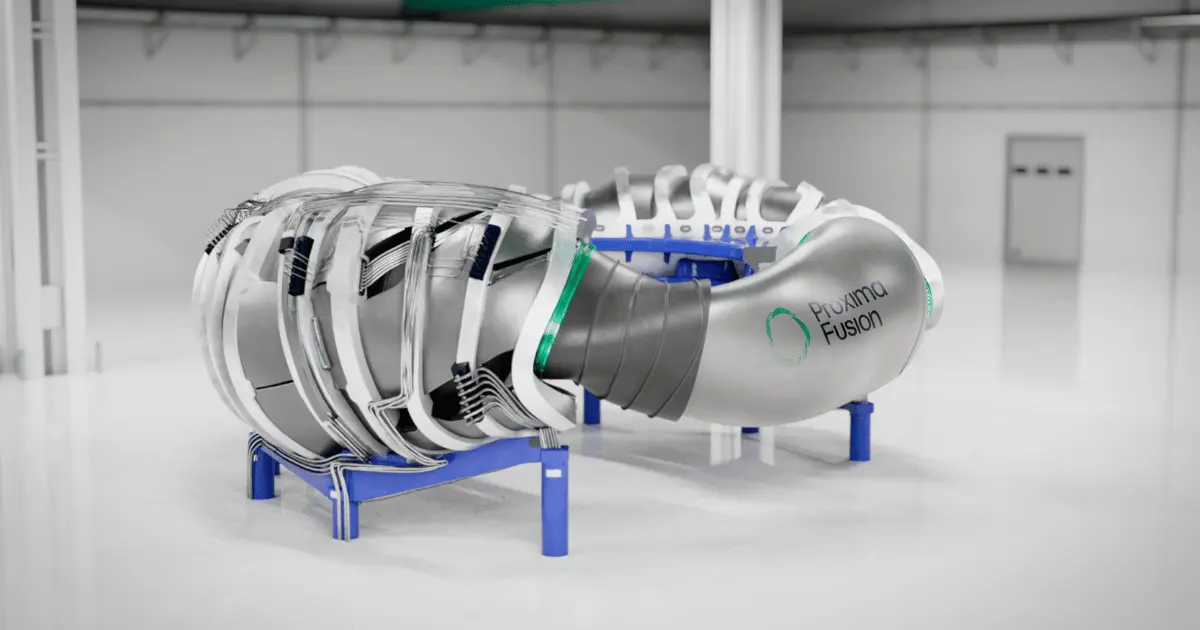
As part of the MoU, we are announcing the siting of the Alpha net-energy-gain demonstrator in Garching, near the Max Planck Institute for Plasma Physics. Our partners at the IPP are expected to take over the device, following its Q>1 demonstration, and operate it as a scientific platform for decades to come, while Proxima goes out and builds Stellaris.
Now, our next step is the construction of a dedicated magnet factory, where we will manufacture the high-temperature superconducting (HTS) magnets at the core of our stellarator concept. These magnets are the enabling technology behind compact, commercially viable stellarators. The factory will be located at RWE's Gundremmingen site – the same location planned for Stellaris, our commercial fusion power plant.
That choice is strategic. Gundremmingen is an existing nuclear-licensed site with infrastructure, grid connections, and the decades of operational expertise of RWE already embedded in them. Proxima’s stellarators won’t need nuclear regulation – they will “just” need radiation protection regulation, like hospitals or particle accelerators. It will definitely be easier to go from the strict fission regulation to fusion radiation protection rather than the other way round. As Markus Krebber noted, the re-use of the Gundremmingen site "increases the speed of implementation and reduces costs – a clear advantage in the global race for the first commercial fusion power plant."
Beginning magnet manufacturing now shortens timelines and strengthens the supply chain for both Alpha and Stellaris. We are directly answering Chancellor Merz's call for Germany's ambition to build the world's first commercial fusion power plant.
The Industrial Coalition Behind Alpha
This industrial push isn't limited to just one site or just 2 companies. With the launch of the Alpha Alliance, more than 30 European industrial companies have joined forces with Proxima, contributing advanced manufacturing, cryogenics, high-performance materials, power electronics, and systems integration expertise.
Anchored around the Alpha project, the Alliance mobilizes Europe's industrial base for delivery and future commercial deployment. By aligning suppliers early around a concrete build program, it supports targeted investment and the development of a coordinated fusion supply chain.
We need all of the Alpha Alliance partners across Europe to not just provide their world-class capabilities, but also invest in expanding them. I'm proud of what this coalition represents… and we're just getting started.
Europe's Fusion Industry Starts Here
Bavaria has chosen to position itself at the forefront of magnetic confinement fusion, and at Proxima, we are turning that ambition into execution. With Alpha set to demonstrate net energy gain in the early 2030s and Stellaris designed to bring fusion power to the European grid soon after, what we are building extends far beyond a regional initiative.
In a global race defined by speed and coordination, Europe must show it can build at scale. With public backing, a mobilized industrial supply chain, and manufacturing preparations already underway, I see Proxima as advancing Europe's most concrete pathway to commercial fusion.
And on a personal level – what we signed last week is the kind of public-private agreement I've always believed was possible, but I’ve never seen executed at this scale. Here we have a state government, a world-class research institute, a major energy company, and a rapidly growing deep-tech startup that align behind a shared mission. That genuinely moves me. This is how society should work. So let me end with a sincere thank you to all people who have been involved in getting this MoU off the ground, across all partners. We can do something spectacular together.
Further Reading
- Financial Times: Nuclear fusion start-up wins Bavarian state backing for €2bn test plant
- Sifted: Nuclear startup Proxima Fusion eyes €1.2bn from German government
- Handelsblatt: Bavaria is investing in the dream of a fusion power plant
- Manager Magazin: Groundbreaking ceremony for Bavaria's two-billion-euro fusion reactor
- BILD: Nuclear fusion in Bavaria: Söder plans groundbreaking reactors
- New Civil Engineer: MoU signed to develop Europe’s first commercial scale nuclear fusion power plant in Germany
- The Economist: At last, reasons to be cheerful about European tech
Related Stories