Proxima Fusion Welcomes Ahmed Diallo as Head of Global Partnerships

Munich, Germany, July 24, 2026 – Proxima Fusion today announced that Ahmed Diallo has joined the company as Head of Global Partnerships.
Ahmed brings more than two decades of experience in fusion, first as a research physicist and later as a leader shaping U.S. federal fusion programs. He spent over sixteen years of his career at Princeton Plasma Physics Laboratory (PPPL), one of the world's foremost fusion research institutions, where his work advanced the plasma physics and diagnostics that magnetic-confinement fusion and microelectronics depends on. As Deputy Director of the Innovation Network for Fusion Energy (INFUSE), he built some of the first bridges between the U.S. national laboratories and private fusion companies, connecting emerging ventures with public research infrastructure to de-risk the technologies commercialization depends on. He went on to help shape the United States DOE’s national fusion strategy as a Program Director at the Advanced Research Projects Agency–Energy (ARPA-E), defining programs that advanced commercial fusion through science and engineering.
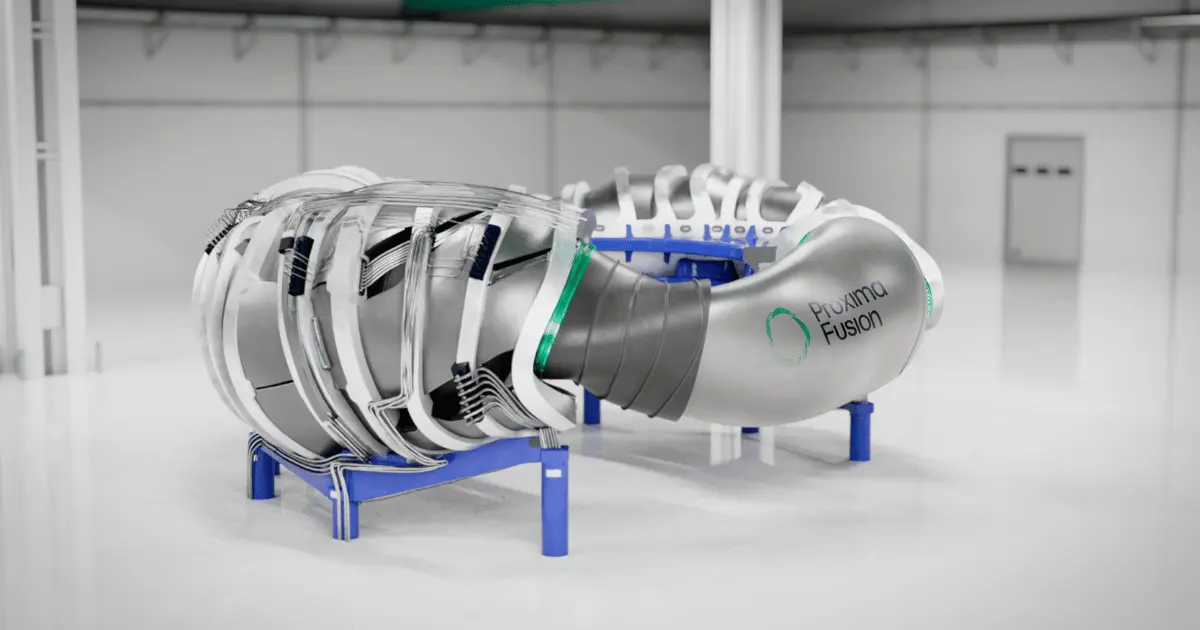
At Proxima, Ahmed will lead the company's global partnerships strategy, forging relationships with governments and public institutions, industrial and supply-chain partners, national laboratories and research organizations. His appointment comes as Proxima scales rapidly: in July, the company announced its latest €411 million financing round, becoming the best-funded fusion company in Europe and best-funded stellarator company world-wide. The company is now advancing toward the Stellarator Model Coil (SMC), which will de-risk high-temperature superconducting technology in 2027; Alpha, the demonstration stellarator designed to achieve fusion net energy gain in the early 2030s; and a few years later Stellaris, the world's first stellarator fusion power plant.
"Building commercial fusion is not something any single company does alone," said Proxima Co-Founder and CEO Francesco Sciortino. "Few people understand as deeply as Ahmed does both the science of fusion and the institutions that will help bring it to the grid. He helped shape the U.S. fusion program and built some of the earliest connections between national labs and private companies. Bringing that experience to Europe, just as we enter our fastest phase of growth, is enormously valuable. We're thrilled to welcome him to the team and back to Europe."
"For years I worked to build the foundations for fusion from inside the public sector – funding the science, de-risking the technology and connecting the people driving it forward," said Ahmed. "The field has reached the point where the last mile should be spearheaded by commercial companies: actually building the machines, not only enabling them. We are at the dawn of a new fusion industry.”
Ahmed’s move to Proxima reflects the opportunity ahead of Proxima and its role in advancing fusion for humanity. He phrases it simply: “Proxima is the clear leader in Europe and one of the most ambitious fusion companies anywhere. I'm looking forward to applying what I've learned across government and national labs in order to make fusion commercially viable, at venture speed. Fusion power is within reach, and I intend to be where it gets built."
Ahmed will be relocating to Munich, where Proxima is headquartered.
About Proxima Fusion
Proxima Fusion is Europe's leading stellarator company and the first spin-out from the Max Planck Institute for Plasma Physics. The company is developing commercial fusion power plants based on the QI-HTS stellarator concept, building on the scientific breakthroughs of the Wendelstein 7-X programme. With Alpha, Proxima is developing a net-energy fusion demonstrator targeted for the early 2030s, paving the way for Stellaris, the world's first commercial stellarator fusion power plant later that decade. This ambition is supported by the Alpha Alliance, a consortium of more than 50 industrial partners, and a distinguished Industrial Development Board. Headquartered in Munich, with offices in Zurich and Oxford, Proxima employs around 200 people across engineering, science and operations.
Related Stories